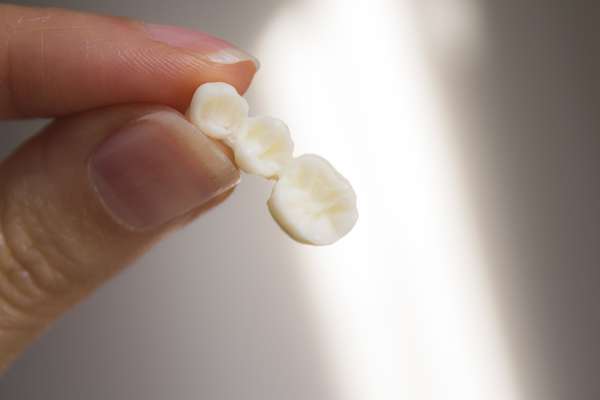
Many dental patients are self-conscious about missing teeth. Depending on the exact teeth that have been lost, this condition can also make it difficult to chew food. In many cases, a dental bridge can be used to replace lost teeth and restore a patient's smile.
How do dental bridges work?
As the name suggests, a dental bridge uses an artificial tooth (called a "pontic") to bridge a gap in a patient's teeth. If pontics are not implanted into the jawbone, they need to connect to existing teeth.
Dental bridges connected to natural teeth
A traditional dental bridge connects the pontic to two dental crowns on either side of the gap. In this procedure, each tooth on either side of the gap is fitted with a dental crown, and the pontic is cemented to each crown. A simpler variant of the traditional bridge is the cantilever bridge, which connects a pontic to a single dental crown.
In some cases, a patient may prefer not to have the teeth on either side of a gap fitted with crowns. For these patients, a Maryland bridge may be a solution. A Maryland bridge also uses a pontic, but it is cemented to the natural teeth on either side of a dental gap. There is no need to fit these teeth with dental crowns, which simplifies the procedure.
Implant-supported bridges
For patients missing multiple teeth in a row, it is impossible to connect a pontic to two natural teeth. In these cases, implant-supported bridges may be advisable. For example, if a patient is missing three teeth in a row, the dental provider may place two implants and cement a pontic in the middle.
Getting implant-supported bridges tends to take longer than with other bridge types. Generally, an initial surgery places the implants, and the bridge is only placed after the implants have healed and successfully integrated with the jawbone. While the procedure takes more time, implant-supported bridges are usually considered to be the most stable and long-lasting bridge option available.
Check out what others are saying about our dental services on Yelp: Dental Bridges in San Antonio, TX.
Is a dental bridge or an implant a better solution?
While dental bridges can be an economical way to replace one or more missing teeth, they do have one important limitation: They usually need to be replaced after between five and 15 years. In younger patients, bridges may not be the first choice for tooth replacement. Some dental professionals may choose to go with a dental implant, which is a more permanent solution.
For patients who are unsure if they need a dental bridge or an implant, it is a good idea to speak with a dental professional. Dentists can talk through the benefits and drawbacks of each option and often will make a recommendation based on the individual patient's circumstances.
Conclusion
Missing teeth can cause problems in everyday life, but patients can consult a dental professional for guidance on their replacement. Thanks to advances in dental technology, dental bridge replacements often blend in with the rest of a patient's new smile.
Request an appointment or call All Smiles Dental Center at 210-714-7429 for an appointment in our San Antonio office.
Recent Posts
Dental bridges are a non-invasive restorative option for replacing missing teeth. However, they require proper care and maintenance to maintain the bridge and the surrounding teeth and gums. A general dentist can provide personalized instructions on caring for one’s bridge according to its type, location in the mouth, and other factors. However, patients can get…
Dental bridges can replace missing teeth effectively and often without needing surgery. Not only will this restore the smile, but it also helps patients avoid the negative oral health effects of missing teeth. A general dentist can determine whether a patient is a good candidate for bridges in a consultation. However, learning the basics can…
Think you might need a dental bridge? Read on to learn more about this restoration. According to the National Institute of Craniofacial and Dental Research, adults aged 20–64 have an average of three decayed or missing teeth. A dental bridge is among the most important restorative dentistry procedures, helping to restore optimal dental health and…