Gum disease starts with the growth of bacteria in the mouth. When brushing or flossing does not remove this bacteria, harmful plaque accumulates and hardens into tartar. The collection of tartar along the gum line results in gingivitis, which can worsen into periodontal disease. Symptoms of this disease can be mild in the early stages, so many patients do not seek care until they reach the advanced stages.
Although gum disease is a preventable condition, it remains one of the leading oral diseases in the United States. In some cases, tooth loss from advanced periodontitis is inevitable. However, with early intervention, a dentist can offer patients treatments to prevent tooth loss. Patients need to understand all treatment options so they can make an informed decision.
Common gum disease treatments
There are two main types of treatment for periodontal disease: non-surgical and surgical. Non-surgical treatment is often the first line of defense against gum disease. However, in cases of severe periodontitis, a dentist may recommend surgical treatment. There are also cosmetic treatments for gum disease that can help a patient feel more confident when smiling.
If your gum disease is in the early stages, the removal of plaque and tartar from above and below the gums may help to halt the progression of the disease and prevent the development of additional problems. This is an important diagnostic and preventive step to take prior to engaging in more extensive treatments.
1. Scaling and root planing
A type of non-surgical periodontal therapy is scaling and root planing. During this procedure, a dentist or hygienist uses scalers and curettes to clean below the gumline. These instruments remove plaque and calculus from the teeth and root surfaces.
The goal of this treatment is to disrupt harmful, disease-causing bacteria that accumulate under the gums, where it is difficult to reach with brushing alone. The dentist or hygienist may perform the procedure over several appointments, so the patient must commit to the treatment. Once the periodontal therapy is complete, the dentist and hygienist instruct the patient on proper home care for the teeth and gums.
2. Laser periodontal therapy
The National Institute of Health notes that dentists first began using dental lasers in the 1960s. However, dentists did not use lasers for periodontal treatment until the 1990s. This relatively new invention has transformed the way that dentists treat gum disease.
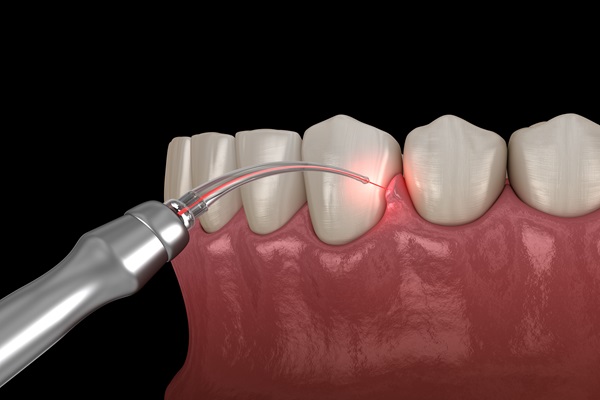
Laser periodontal therapy is another non-surgical intervention that dentists use to restore patients to periodontal health. The bacteria responsible for periodontal disease destroy the attachment of the gum tissue to the teeth. The goal of laser treatment is to eliminate harmful bacteria and encourage reattachment of the gums to the teeth to prevent future issues.
3. Gingival grafting and contouring
Periodontitis can cause gum recession, which makes the teeth look longer than before. Gingival grafting, a type of periodontal surgery, can cover the exposed root surfaces caused by gum recession. Because the root surface is softer than enamel, it is more sensitive. It can also be more prone to dental decay. Covering these surfaces with a gingival graft can be beneficial for the patient's overall dental health.
Some forms of gum disease can also cause gingival overgrowth, making the teeth look smaller than before. A dentist can use a laser to remove excess dental tissue. Alternatively, they may perform a surgical procedure known as a gingivectomy to eliminate extra gum tissue.
Other treatments
Additional surgical treatments are available for periodontal disease, including pocket reduction surgery, in which the gums are lifted and tartar is removed from under them. This procedure decreases the space between the teeth and gums, lessening the potential for harmful bacteria growth. This type of surgery may be combined with guided tissue regeneration, which inserts a piece of mesh between the bone and gums to prevent the gum tissue from intruding on the bone area. This enables the connective tissue to re-grow and improve support for the teeth.
Antibiotic treatments may be combined with surgery or implemented as a solo treatment to reduce the bacteria growth that accompanies gum disease. Prescription medication chlorhexidine is available as a rinse or slow-release chip to control plaque and gingivitis.
Conclusion
Gum disease is a chronic dental condition that can easily become advanced with very little warning. By maintaining proper oral hygiene and visiting the dentist regularly for professional cleaning and checkups, patients can ensure they receive an early diagnosis of gingivitis before it progresses to more serious stages. Once periodontitis becomes an issue, patients should partner with their dentist to determine the safest and right course of treatment.
Request an appointment here: https://www.allsmilesdentalcenter.com or call All Smiles Dental Center at (210) 714-7429 for an appointment in our San Antonio office.
Check out what others are saying about our dental services on Yelp: Gum Disease in San Antonio, TX.
Recent Posts
Concerned about receding gums? Read on to learn more about this condition and how it presents itself. You may be able to notice receding gums by simply examining the appearance of your gums at home. If you notice your gums are pulling away (receding) from gums, then you are most likely experiencing gum recession. However,…
Receding gums can be the result of plaque build-up underneath gum tissues. The bacteria in plaque can infect tissues underneath the gums, activating the body’s inflammatory response. The inflammation leads to gum tissues pulling back from teeth roots, exposing said roots to acids made by oral bacteria.Teeth roots do not have the luxury of being…
Receding gums can be a symptom of gingivitis, the first stage of gum disease. It can also be caused by other factors, like a genetic predisposition to developing gum recession or bad brushing techniques.Gingivitis occurs when plaque and tartar make their way below gum tissues. The bacteria inside them infect gum tissues, leading to an…
Receding gums can be a symptom of gum disease, an infection of gum tissues caused by the bacteria in plaque and tartar. Plaque is a sticky film that builds on teeth as bacteria convert sugars into acids that damage teeth. It turns into tartar when left on teeth for a few days.Gum disease is one…